
Appetizers
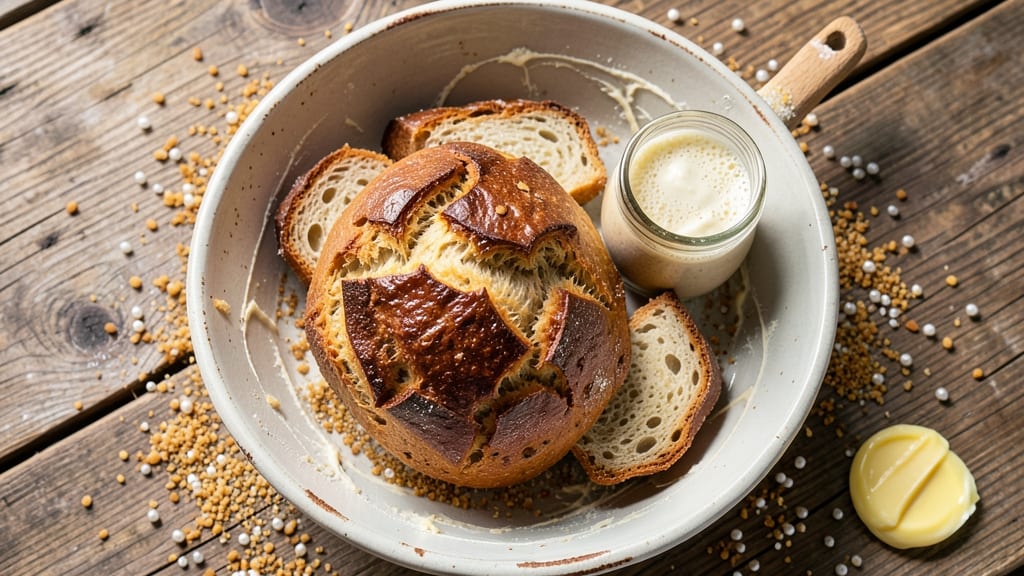
This artisan sourdough bread recipe with starter transforms simple flour and water into a golden-crusted, tangy masterpiece with just 24 hours of patience. The key lies in your starter—a living culture that develops depth and complexity over time.
Unlike commercial yeast, sourdough’s fermentation creates that unmistakable flavor, and this method balances tradition with modern shortcuts for consistent results.
The process begins with your starter, which requires careful feeding to maintain its vitality. Once active, we’ll mix the dough with precise hydration and gluten development in mind, then let it ferment at room temperature before an overnight cold proof for enhanced flavor.
The Dutch oven creates steam during baking, ensuring that crispy crust and open crumb structure you crave.
Scoring the dough before baking isn’t just decorative—it controls expansion and creates those signature ear-like patterns. The result? A loaf with a shatteringly crisp crust, an airy interior, and a tangy depth that disappears when sliced too thin.
This recipe builds confidence for beginners while satisfying the perfectionist in every baker.
Perfect for breakfast toast, sandwiches, or gifting, this sourdough becomes even better as it stales—ideal for meal prep. The science behind hydration, fermentation times, and oven techniques ensures you’ll achieve restaurant-quality results at home, every time.
Ingredients for artisan sourdough bread recipe with starter
Nine ingredients—flour, water, patience—create restaurant-quality sourdough at home.
| Ingredient | Amount | Notes |
|---|---|---|
| Unbleached All-Purpose Flour 🌾 | 5 cups | Bread flour alternative if unavailable |
| Active Sourdough Starter 🍞 | ½ cup | 100% hydration, bubbly and doubled |
| Filtered Water 💧 | 3 ½ cups | Room temperature preferred |
| Sea Salt 🧂 | 1 ½ tsp | Fine grain preferred |
| Vegan Butter 🧈 | 2 tbsp | Melted for brushing crust |
| Cornmeal 🌽 | ¼ cup | For dusting Dutch oven |
| Olive Oil 🫒 | 1 tbsp | Extra-virgin for brushing |
| Flaxseed Meal 🌿 | 1 tbsp | Mixed with 3 tbsp water for egg wash |
| Instant Yeast 🍞 | ¼ tsp | Optional for faster rise |
Your starter is the soul of this bread. King Arthur or Bob's Red Mill flours work best—their high protein content develops gluten beautifully. For the starter itself, Whole Foods bulk bins often have the most active cultures, or maintain your own in a jar. The key is its vitality: it should float in water when active. If yours isn't ready, feed it 1:1:1 (flour:water:starter) twice daily for 24 hours to wake it up. Room temperature water is crucial—cold water slows fermentation, while hot can kill the culture. For the flour, white whole wheat or rye can replace 10% of the all-purpose for extra depth.
No vegan butter? Coconut oil or olive oil work in a pinch, though butter gives that signature richness. Short on cornmeal? Semolina or rice flour create similar crisp crusts. The flax egg wash (1 tbsp flax + 3 tbsp water) mimics egg wash perfectly—let it sit 5 minutes to thicken. For the yeast: while traditional sourdough relies solely on the starter, adding 1/4 tsp instant yeast helps beginners achieve consistent rises. The salt is non-negotiable—it regulates yeast activity and enhances flavor, but Diamond Crystal kosher salt dissolves faster than Morton's. Need to substitute? Malt powder (1 tsp) or a pinch of baking soda can help with browning if you're avoiding salt entirely.
Starter can be stored in the fridge for 1 week—feed it weekly to maintain activity. Flour keeps indefinitely in airtight containers, but freeze for 24 hours to kill weevils if you're concerned. The dough itself ferments best at 75°F (24°C)—use your oven light to warm the space if needed. After baking, cool completely on a wire rack (never stack loaves). This bread stales faster than commercial varieties, but toast within 2 days for peak crispness. For leftovers, wrap tightly and freeze slices—toast straight from frozen for that fresh-baked crunch.
Why You'll Love This Recipe
- No-Knead Magic: I swear by this—just mix the flour, starter, and water, let it rest, then shape it. No stand mixer, no fancy techniques, just a bowl and patience. That’s it. The dough handles like a dream, even for beginners.
- Tangy Crust, Soft Core: The sea salt cuts through the deep, funky tang of the starter while the vegan butter brushes into a golden crust that’s crisp enough to hold your coffee. Honestly, it’s the kind of bread that makes you slow down and actually taste your morning.
- Weeknight Wonder: This bread is my go-to for meal prep—I bake a loaf on Sunday, and it’s still fresh enough for sandwiches by Wednesday. Or freeze slices for quick toast later. (Yes, even on a Tuesday night.)
- Budget-Friendly Staple: Five ingredients, zero waste. The starter keeps forever, the flour lasts months, and a single loaf stretches into toast, croutons, or French toast for days. I’ll be real: it’s the most cost-effective way to feel like you’re eating at a bakery.
Step-by-step instructions for artisan sourdough bread
Here's how to craft a rustic sourdough loaf with a crisp golden crust and tender crumb—no fancy equipment required.
Mix the Dough and Begin the Bulk Fermentation
In a large mixing bowl, combine the 5 cups unbleached all-purpose flour and 0.5 cup active sourdough starter. Make a well in the center and add 3.5 cups filtered water and 1.5 tsp sea salt. Using a wooden spoon or your hands, mix vigorously until a shaggy dough forms. The dough will be sticky—this is normal with sourdough.
Once the dough comes together, let it rest for 5 minutes. Then, using wet hands, knead gently for 5-7 minutes until smooth and elastic. The dough should be tacky but not wet. Cover the bowl loosely with plastic wrap and let it ferment at room temperature for 4-6 hours, or until it has roughly doubled in size and looks puffy with bubbles throughout. This bulk fermentation develops flavor and structure—don't rush it.
Shape and Prepare for Final Proof
After the bulk fermentation, turn the dough onto a lightly floured surface. Gently deflate it and shape into a round boule. To do this, tuck the edges under and roll the dough toward you while rotating the bowl. The goal is to create surface tension for an open crumb later. Place the shaped dough, seam-side up, into a bowl lined with a clean kitchen towel.
Cover loosely and let it proof at room temperature for 1-2 hours, or until it has risen by about 50%. The dough should feel springy when poked gently. Meanwhile, preheat your oven to 450°F with a Dutch oven inside for 45 minutes. The Dutch oven will create steam for that signature crust. Dust the inside of the Dutch oven with 0.25 cup cornmeal to prevent sticking.
Score and Bake for Maximum Crust Development
Carefully transfer the proofed dough to the hot Dutch oven using the kitchen towel. Score the top with a sharp razor or lame in a few diagonal slashes—this helps control expansion and adds visual appeal. Immediately reduce the oven temperature to 425°F and bake covered for 20 minutes. This steam phase builds the oven spring and prevents cracking.
After 20 minutes, remove the lid and continue baking for another 20-25 minutes until the crust is deep golden brown and the internal temperature reaches 205-210°F. You'll smell that unmistakable sourdough aroma—this is your cue that it's ready. If the crust isn't dark enough, broil for 1-2 minutes at the end, watching closely to avoid burning.
Finish with Flavor-Enhancing Brushes
Remove the bread from the Dutch oven and transfer it to a wire rack to cool completely. While still warm, brush the crust with a mixture of 1 tbsp flaxseed meal and 3 tbsp water (this acts as an egg wash substitute) and 1 tbsp olive oil for added shine and flavor. For extra richness, brush the top with 2 tbsp melted vegan butter while it's still warm—this creates a glossy finish and enhances that artisanal look.
Let the bread cool for at least 1 hour before slicing. The interior should be tender with an open crumb, while the crust should be crisp and capable of holding up to a hearty sandwich. The tangy depth from the sourdough starter will develop further as it cools. Store any leftovers wrapped in a clean towel to maintain freshness for up to 3 days.
Pro Tips For Making Artisan Sourdough Bread Recipe With Starter
- STRETCH AND FOLD: Use a bench scraper instead of your hands to fold the dough—it’s faster and gives you better control. I learned this the hard way after tearing my knuckles on a stubborn dough that just wouldn’t cooperate.
- WEIGH YOUR STARTER: Skip the eyeballing and measure your active starter by weight (usually 10-20% of your flour). A digital scale makes this foolproof—no more guessing if your starter’s actually ready or if you’re underfeeding the dough.
- SALT THE WATER: Dissolve the sea salt directly into the filtered water before mixing it with flour—this ensures even distribution. I used to sprinkle it on top, and half the time it clumped in the dough like a bad surprise.
- DAMPEN THE OVEN: Place a metal tray filled with boiling water in the oven before baking to create steam. This isn’t just for show—it guarantees that crust you’re craving without needing a fancy Dutch oven. (Yes, even if you’re impatient like me.)
Creative variations of artisan sourdough bread recipe with starter
Whole Grain Boost
Swap 1 cup of the all-purpose flour for whole wheat or rye flour to add nutty depth and extra fiber. I like King Arthur whole grain flour because it blends well without making the dough too dense.
For a lighter texture, replace ½ cup with spelt flour—it has a sweeter flavor and better rise. Just be prepared for a slightly shorter shelf life, as whole grains stale faster. 🌾
Herb-Infused Dough
Add 1 tbsp fresh rosemary or thyme directly to the dough during bulk fermentation for an aromatic twist. I also like 1 tsp garlic powder mixed into the flour before combining—it develops beautifully during fermentation.
For a Mediterranean touch, try 1 tbsp dried oregano or crushed fennel seeds. These herbs pair perfectly with the tangy sourdough flavor.
Seeded Variations
Mix 2 tbsp chia seeds or sunflower seeds into the dough for extra crunch and nutrition. I recommend toasting the seeds in a dry pan for 2 minutes before adding to enhance their flavor.
For a classic seed blend, combine 1 tbsp each of sesame, poppy, and flaxseeds—they’ll create beautiful speckles in the crumb. These additions also add visual appeal to your loaf.
Sweet Sourdough
Create a cinnamon-raisin loaf by adding ½ cup raisins and 1 tsp cinnamon to the dough. I like to soak the raisins in 2 tbsp warm water mixed with 1 tbsp maple syrup for 10 minutes before incorporating.
For a richer version, fold in ¼ cup chopped walnuts or pecans—they add texture and buttery flavor. Brush the crust with maple syrup instead of oil for a caramelized finish.
Savory Additions
Transform your sourdough into a cheesy pull-apart loaf by mixing in ½ cup shredded vegan cheddar or nutritional yeast during the final knead. I also love 1 tbsp smoked paprika for depth—it pairs wonderfully with the tang.
For a heartier version, add ¼ cup chopped sun-dried tomatoes or caramelized onions. These additions work best when folded in during the final proof for even distribution.
Global Twists
Make a Focaccia-style sourdough by shaping the dough into a flat rectangle, dimpling the top with your fingers, and brushing with olive oil before baking.
For an Irish soda bread variation, replace the starter with 1 tsp baking soda and add ½ cup buttermilk—this creates a dense, crumbly loaf perfect for toast.
For a Japanese-inspired version, add 1 tsp miso paste to the dough and bake until deep brown for a savory, umami-rich loaf. 🗺️
Nutrition facts
Frequently asked questions about artisan sourdough bread
How do I know if my sourdough starter is ready?
Your starter should be doubled in size with plenty of bubbles when poked—this usually takes 4-6 hours after feeding. It should also float in water when dropped in. If it smells slightly tangy but not rotten, it's ready. For best results, feed it 1:1:1 (flour:water:starter) 2 hours before using for maximum activity.
Can I make this recipe without a Dutch oven?
Yes! If you don't have a Dutch oven, use a baking stone or steel on the lowest oven rack. Place a metal bowl filled with boiling water on the middle rack to create steam. Score the dough and bake at 450°F for 20 minutes covered with foil, then 20-25 minutes uncovered. The crust won't be as crispy but still delicious.
Why did my sourdough collapse during baking?
This usually happens from overproofing or insufficient gluten development. For the first issue, check your dough's readiness by doing the "poke test"—it should spring back slowly (not fast). For gluten, knead longer (up to 10 minutes) or autolyse (mix flour and water first, rest 30 minutes before adding salt/starter). Also ensure your oven is fully preheated with proper steam.
How long should I let the dough ferment?
Bulk fermentation should take 4-6 hours at room temperature (75°F/24°C) until doubled with bubbles. Cold proofing overnight (12-16 hours) in the fridge enhances flavor. For faster results, use a warmer spot (like a turned-off oven with light on) but don't exceed 8 hours total at room temp or the dough may overproof.
Can I use this recipe with a different flour?
Yes! For a lighter texture, try bread flour (higher protein). For nutty flavor, replace 1 cup with whole wheat or rye. Spelt flour adds sweetness but requires slightly more water. Just note that whole grains absorb moisture faster—adjust water by 1-2 tablespoons if needed. Always measure flour by weight (1 cup = 120g) for consistency.