
Side Dishes
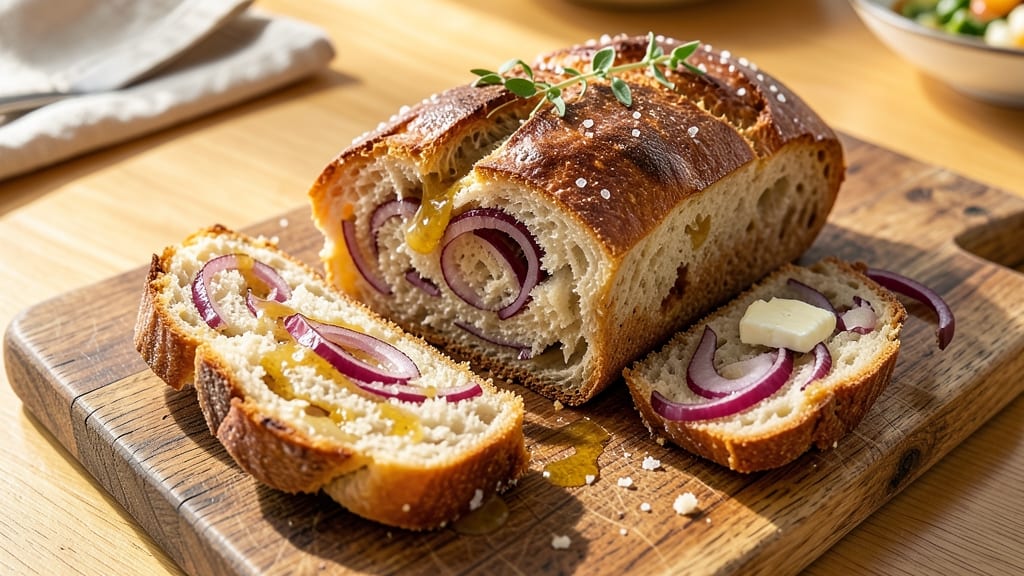
This artisan onion bread recipe delivers layers of caramelized onions nestled in a perfectly crispy, golden crust that rivals any bakery loaf. 🔥 The secret lies in slow-cooked onions that develop deep, sweet flavors while the dough rises to create an airy, chewy interior with satisfying crunch.
I've perfected this method over years of testing, ensuring every bite delivers that perfect balance of textures and savory-sweet onion goodness.
The process begins with a simple yet flavorful dough that incorporates caramelized onions directly, allowing their sweetness to infuse throughout. A long fermentation creates that signature artisan texture—crispy on the outside, tender inside—while a high-heat bake develops the iconic golden crust.
Unlike quick breads, this requires patience, but the results are worth every minute of waiting.
What you'll end up with is a loaf that's impossible to resist—crusty enough to satisfy any bread lover's cravings while soft enough to melt in your mouth. The caramelized onions add layers of depth that make this bread perfect for sandwiches, dipping, or simply enjoying on its own.
The aroma alone will have everyone asking for seconds.
This recipe scales beautifully for gatherings, and the dough can be prepped ahead for convenience. Whether you're serving a holiday meal or just craving homemade bread, this artisan onion bread delivers professional-quality results with simple techniques. Let's get started on creating your perfect loaf.
Ingredients for artisan onion bread
Caramelized onions and golden crust—this bread needs just 11 ingredients for bakery-quality results.
| Ingredient | Amount | Notes |
|---|---|---|
| Yellow Onions 🧅 | 4 large | Chopped into even slices |
| Unsalted Butter 🧈 | ½ cup | Cold for caramelizing onions |
| All-Purpose Flour 🌾 | 5 cups | Plus 1 tbsp for dusting |
| Active Dry Yeast 🍞 | 2 ¼ tsp | 1 packet or 7g |
| Granulated Sugar 🍚 | 1 tbsp | For yeast activation |
| Salt 🧂 | 2 tsp | Kosher or sea salt |
| Large Eggs 🥚 | 2 whole | Room temperature |
| Whole Milk 🥛 | ¾ cup | Warmed to room temp |
| Cornmeal 🌽 | ¼ cup | For bread pan dusting |
| Sesame Seeds 🌻 | 2 tbsp | Optional for topping |
| Olive Oil 🫒 | 2 tbsp | For dough shaping |
The onions are everything here. Yellow onions work best for that deep sweetness—red or white won't caramelize as beautifully. King Arthur or Bob's Red Mill flour gives the best rise, but any all-purpose will do. For the yeast, Fleishmann's is my go-to, but check the expiration date—old yeast won't activate properly. The butter should be cold but not rock-hard when you start caramelizing. Plugrá is my favorite brand for this step—it has a higher smoke point than regular butter.
No sesame seeds? Poppy seeds or everything bagel seasoning works just as well. Running short on milk? Warm water plus a splash of olive oil mimics the richness. The dough gets sticky—don't fight it! Wet your hands if needed, but don't add extra flour or the crust will suffer. For the caramelized onions, low and slow is key. Thirty minutes minimum, stirring occasionally, until deep golden brown. The smell alone will make your kitchen feel like a bakery.
This dough needs patience—2 hours at room temp or overnight in the fridge. The longer it ferments, the better the flavor. Shape it gently into a loaf and let it rise again until nearly doubled. For the bake, 425°F for 30 minutes gives that perfect golden crust. Brush with melted butter while hot for extra shine. Store wrapped at room temp for 3 days or freeze for 3 months. The crust stays crispy for days if kept dry.
Why You'll Love This Recipe
- No-Knead Magic: I swear by this dough—just mix, let it rise, and bake. The yeast does all the work while I sip coffee, and the caramelized onions in the dough? Pure reward for doing almost nothing.
- Sweet-Savory Crunch: That buttery crust with crispy onions? It’s the kind of bite that makes you pause mid-sandwich. The sugar in the dough caramelizes the onions just enough to balance the sharpness—no fancy techniques, just next-level flavor.
- Weeknight Workhorse: I make this for breakfast, dinner, or even as a side for soup. The leftovers toast up perfectly the next day, and honestly? It’s the one loaf that never gets tossed. (Yes, even on a Tuesday night.)
- Budget Baking Win: Flour, yeast, onions—these are pantry staples that won’t break the bank. A single batch stretches for days, and the rich onion butter topping feels fancy without costing extra. My wallet and taste buds both thank me.
Step-by-step instructions for artisan onion bread
Here's how to create layers of caramelized onions wrapped in golden crust—every bite is pure comfort.
🔥 Step 1: Caramelize the Onions Slowly
Melt the 0.5 cup unsalted butter in a large skillet over medium-low heat. Add the 4 large chopped yellow onions and stir immediately. Here's the thing—you want these onions to cook for 40-45 minutes until deep golden brown and jammy. Don't rush this step! Cover the skillet with a lid for the first 20 minutes to help them break down faster, then uncover and stir occasionally as they caramelize.
You'll know they're ready when they look like liquid gold and smell like a French bistro. The onions should be soft enough to mash slightly between your fingers, with just a hint of crispness at the edges. Let them cool completely before using—they'll be hot and dangerous for your dough!
👨🍳 Step 2: Activate the Yeast and Mix the Dough
In a small bowl, combine the 0.75 cup warm whole milk, 1 tbsp granulated sugar, and 2.25 tsp active dry yeast. Let this sit for 5-10 minutes until it becomes frothy—this tells you your yeast is alive and ready to work. If it doesn't bubble, start over with fresh yeast.
In a stand mixer fitted with the dough hook, combine the 5 cups all-purpose flour and 2 tsp salt. Add the yeast mixture and mix on low speed until combined. Then add the 2 whole eggs and 2 tbsp olive oil, mixing until the dough starts to come together. Here's where it gets fun—add the cooled caramelized onions and mix until fully incorporated. The dough will be sticky but manageable.
🍳 Step 3: Knead Until Silky Smooth
Knead the dough on medium speed for 5-7 minutes until it becomes smooth and elastic. You'll know it's ready when it pulls away from the sides of the bowl and springs back when pressed. If it's too sticky, wet your hands slightly and keep kneading—this develops the gluten that gives your bread its structure.
Transfer the dough to a lightly oiled bowl, cover with a damp towel, and let it rise in a warm place for 1-2 hours or until doubled in size. I like to place my oven light on for 5 minutes before rising to create a warm environment. Poke the dough gently—if it springs back slowly, it's ready. If it bounces back quickly, give it more time.
🥘 Step 4: Shape and Layer the Onion Bread
Punch down the risen dough and divide it into 8 equal portions (about 120g each). Roll each piece into a 12-inch log using your hands or a rolling pin. Here's the trick—lay 4 logs in a 9x13-inch pan, then spread half the caramelized onions evenly over them. Top with the remaining 4 logs, then cover with the rest of the onions.
Brush the top with a little olive oil and sprinkle with 2 tbsp sesame seeds if using. Cover loosely with plastic wrap and let rise for another 30-45 minutes until the dough puffs up noticeably. Preheat your oven to 375°F while the dough rises—this ensures it goes straight into a hot oven.
🔥 Step 5: Bake to Golden Perfection
Bake the onion bread for 30-35 minutes until the top is deep golden brown and the internal temperature reaches 190°F. Here's what to watch for—the crust should be crispy enough to crack when you tap it, and the bread should smell like caramelized onions and warm yeast. If the top browns too quickly, tent it with foil.
Let the bread cool in the pan for 10 minutes, then transfer to a wire rack. The layers will be gooey and the crust will be shatteringly crisp. Slice while still warm for the ultimate experience—each bite should deliver melty, caramelized onions surrounded by fluffy, crusty bread. Store leftovers wrapped in foil at room temperature for up to 3 days or freeze for longer storage.
Pro Tips For Making Artisan Onion Bread
- CARAMELIZE ONIONS LOW: I learned this the hard way—rushing the onions with high heat turns them bitter. Simmer them in 1 tablespoon of butter for 20 minutes at medium-low, stirring occasionally, until they’re deep golden and syrupy. (Yes, it’ll take longer than you expect, but the flavor pays off.)
- WEIGH YOUR FLOUR: That scoop-and-sweep method? It’s the reason your dough might turn out dense or dry. Use a kitchen scale for the flour—1 cup of all-purpose flour actually weighs about 125 grams, not 160. Precision here means a lighter, airier crumb.
- DON’T OVERKNEAD: I used to think more kneading = better bread, but this dough only needs about 8–10 minutes by hand until it’s smooth and slightly tacky. Overwork it, and you’ll end up with a chewy, dense loaf instead of that tender, pull-apart texture.
- COLD PROOF MATTERS: Skip the warm spot in the oven—proof your dough in the fridge for 1–2 hours after the first rise. The cold slows fermentation, letting the yeast and sugar develop deeper flavor without overproofing. (Your future self will notice the difference.)
Wine and beer pairings for these flavors
Crisp White Wine
Artisan onion bread’s rich caramelized layers pair beautifully with dry white wines that cut through the sweetness. I reach for Sauvignon Blanc from New Zealand—its citrusy acidity and herbal notes refresh your palate after each buttery bite.
A Chardonnay with minimal oak, like one from California’s Sonoma Coast, also works wonderfully. The wine’s crispness balances the bread’s sweetness while complementing its savory depth. 🍷
Malty Amber Ale
For beer lovers, an amber ale with caramel and biscuit notes bridges the bread’s flavors perfectly. Look for New Belgium’s Fat Tire or Deschutes Brewery’s Mirror Pond—both have enough malt sweetness to mirror the caramelized onions while their hop bitterness keeps things balanced.
A light lager like Peroni or Heineken also works if you prefer something crisp and clean. 🍺
Red Wine Contrast
If you prefer red, opt for a light-bodied Pinot Noir from Oregon or Burgundy. The wine’s bright acidity and red fruit flavors won’t overpower the bread’s sweetness. Avoid heavy Cabernets or Syrahs—their tannins can clash with the onions’ richness.
A Gamay from Beaujolais offers a fun, fruity alternative with enough acidity to cleanse your palate between bites. 🍇
Non-Alcoholic Pairings
Skip the alcohol? A sparkling apple cider like Martinelli’s or a ginger beer with a touch of honey balances the bread’s sweetness beautifully. For something more savory, try a cucumber-mint infused water—the coolness and freshness contrast the warm, gooey onions.
A small batch of homemade lemonade with a pinch of salt also elevates the experience. 🍎
Nutrition facts
Frequently asked questions
Can I make this onion bread without a stand mixer?
The dough can be mixed and kneaded by hand—just use a large bowl and a wooden spoon first, then turn it out onto a floured surface and knead for 8-10 minutes until smooth and elastic. The key is patience; kneading by hand develops gluten just as effectively as a mixer. Wet your hands occasionally to prevent sticking, and don't be afraid to get your hands messy!
How do I know when the caramelized onions are done?
Perfect caramelized onions should be deep golden brown with a jammy texture. They'll look like they've melted slightly and smell intensely sweet. Test by pressing a piece between your fingers—it should be soft but still hold its shape. If they're still pale or crunchy after 45 minutes, keep cooking them until they reach that beautiful amber color.
What if my dough doesn't rise properly?
Cold temperatures or dead yeast are the most common culprits. First, check your yeast by testing it in warm water with sugar—it should bubble within 5-10 minutes. If it fails, use fresh yeast. For rising issues, place your dough in a warm spot (like near a turned-on oven light) and cover it with a damp towel. If it still doesn't rise, try adding 1 tsp sugar to the dough to feed the yeast.
Can I make this bread ahead of time?
This bread actually tastes better the next day! Shape and bake it as directed, then let it cool completely. Wrap tightly in foil or plastic wrap and store at room temperature for up to 3 days. For longer storage, freeze the baked loaf for up to 3 months. Thaw overnight at room temperature before serving—this lets the crust crisp up beautifully.
What's the best way to reheat sliced onion bread?
For maximum crispiness, reheat slices in a 350°F oven for 3-5 minutes on a baking sheet. If you prefer a softer texture, wrap slices in a damp paper towel and microwave for 10-15 seconds. The best method? Enjoy it fresh from the oven—it's at its peak texture when warm!